
Charter Bus to Miami Cruise Port for Groups: Coordinating Family Reunions, Church Groups, and Multi-Cabin Cruise Parties
Charter Bus · 10 min read
Coordinating transportation for a family reunion sailing out of Port of Miami, a church group’s annual cruise departing Port Everglades, or a multi-cabin birthday cruise with 40 of your favorite people is a different animal than booking a single car to the port. Pickup patterns multiply, vehicle capacity math matters, luggage logistics get real, and timing has to work for everyone.
This guide walks through how to think about charter bus rental from South Florida to Port of Miami or Port Everglades for a group of 20 or more: the three pickup patterns, vehicle sizing, cost math, and when to lock in the booking. If you want the broader framework for renting a charter bus in South Florida across any trip type, our complete charter bus rental guide for South Florida covers quoting mechanics, vehicle types, and booking basics. This post picks up where that one leaves off and drills into what group cruise coordinators specifically need to know, including the cruise port transportation logistics unique to moving a large group to the terminal together.
What Changes When You're Moving 20+ People to the Cruise Port
One car to the cruise port is a straightforward booking. Twenty cars to the cruise port is not — and it’s not what groups actually do. Group cruise transportation scales a half-dozen moving parts at once: pickup coordination (one address or several?), vehicle capacity math (seats plus luggage), timing alignment across staggered check-in windows, and the per-person cost math that families and treasurers want to see before they collect money from the group.
The three pickup patterns most group cruises fall into are worth knowing by name before you quote, because the pattern you choose shapes the vehicle size, the departure time, and the total cost.
Single-hotel pickup. Everyone meets at one hotel the night before or the morning of the cruise. One bus, one trip to the port. This is the easiest pattern to execute and the cheapest per rider because the vehicle doesn’t accumulate loop time. Common for family reunions where the group has booked a base hotel together, and for church groups that charter a room block at a single property.
Multi-hotel coordination. The group is spread across two to four hotels in the pre-cruise days, and the coach runs a loop to collect everyone before heading to the port. Each additional hotel adds roughly ten to twenty minutes of loop time depending on distance and traffic. If your group spans more than three or four properties, running two coaches on parallel pickup loops often beats running one coach on a long single loop. Our hotels near Miami cruise port guide covers the properties that most commonly show up in multi-hotel pickup patterns.
Meet-at-airport. Group members fly in from multiple cities on different flights, consolidate at Fort Lauderdale-Hollywood (FLL) or Miami International (MIA), and transfer directly to the port. The planning challenge here is scheduling pickup around the latest-arriving flight in the group — or splitting into two transfers if the arrival spread is too wide. Our airport-to-cruise-port transfer guide covers the routing specifics for both airports to both ports.
Then there’s the timing math. Modern cruise lines space check-in by cabin assignment, so a 40-person group often has check-in windows that span two or more hours. You can’t time the bus for the latest window — people with earlier check-in slots sit in the terminal lounge, which is fine. You can’t time it for the earliest window either without a healthy buffer, or the stragglers end up in a scramble. The standard move: time pickup for the earliest check-in in the group plus a traffic buffer, and plan for a rideshare backup for anyone running significantly late. For the full embarkation day timeline — pre-boarding steps, luggage drop, terminal flow — see our cruise embarkation day timeline. If your group is still deciding between Port of Miami and Port Everglades, our Port of Miami vs. Port Everglades comparison walks through the pros and cons of each.
What a Group Cruise Transfer Actually Costs
Group charter bus transfers are priced per vehicle, not per person — so the per-person math gets better as your group fills the bus. Here are six cost drivers to factor into your quote conversation:
1. Per-vehicle pricing is the baseOperators quote the vehicle, not the headcount. A 50-person group and a 40-person group on the same coach pay the same base rate — the difference is per-person, not total. For general charter bus rental cost framing across any trip type, our rental guide walks through what drives the base rate.
2. Industry pricing ranges by vehicle typeFor a one-way local transfer from a South Florida hotel to Port of Miami or Port Everglades in the 2026 market, a full-size motor coach typically runs in the several-hundred-to-roughly-one-thousand-dollar range. Mini-coaches run lower; executive Sprinter vans lower still. Your actual quote depends on vehicle availability, pickup complexity, and sail date.
3. Add-ons that should be line items in a clean quoteSunPass tolls, port terminal pass-through fees, extended wait time if boarding runs long, and driver gratuity (industry norm is ten percent) should appear as separate line items — not folded into a vague “total.” Ask the operator to spell out what’s included versus what’s add-on at the quote stage.
4. Hours of Service second-driver costFederal Hours of Service rules cap a single driver at ten hours of active driving in a shift. A straightforward hotel-to-port transfer doesn’t trigger this, but a multi-stop day — airport pickup, hotel loop, port drop — can. A second driver typically adds roughly three to five hundred dollars and needs to be in the quote up front rather than surfacing on the invoice.
5. Deposit and payment termsMost charter operators require ten to twenty-five percent at booking to hold the date, with the balance due before or on the day of service. Churches and schools operating on purchase orders should confirm PO policies up front — some operators accept POs, some require a card on file. Payment logistics have killed more bookings at the eleventh hour than pricing has.
6. Round-trip vs. one-way pricingBooking a round-trip arrangement — the pre-cruise transfer plus the post-cruise return — at the same time usually prices better than two separate bookings and locks in the return vehicle in advance. More on the return leg in the booking timeline below.
Get a Group Transportation Quote
Group cruise transportation is priced per vehicle, not per person — so the per-person cost drops as your group fills the bus. Send us your group size, pickup locations, and sail date, and we’ll size the vehicles and run the per-person math.
Vehicle Options by Group Size for Cruise Port Transfers
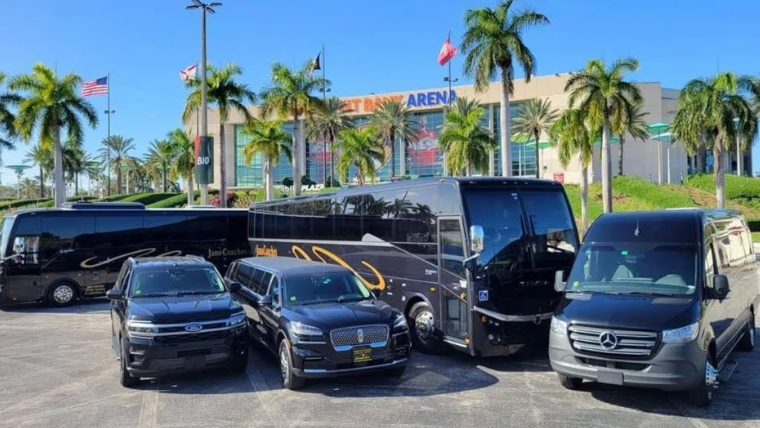
Right-sizing the vehicle to your actual group size — including gear and luggage — is the single most consequential call a first-time group coordinator makes. Under-size and you leave people or bags behind; over-size and the per-person math gets ugly. Four standard tiers cover almost every group cruise scenario in South Florida:
Executive Sprinter Van (8-14 Passengers)
The small-group tier. Best fit for a core-family subset of a larger reunion, a small Bible study or ministry team heading to a church cruise, or an adult-only sub-group peeling off from a bigger multi-generational trip. Easiest vehicle to park at hotels with tight pickup zones. Rear cargo and overhead space handles roughly twelve to fourteen standard suitcases plus carry-ons.
Mini-Coach (15-35 Passengers)
The mid-size group tier. Common fit for extended family reunions, mid-size church groups, and affinity-group cruises in the 20-30 range. Overhead storage plus some undercarriage storage depending on the model. For youth-group transportation specifically — sports teams, school trips, youth retreats — our charter bus for youth sports and school trips guide covers the credentialing and safety specifics that apply when minors are on board.
Full-Size Motor Coach (35-55 Passengers)
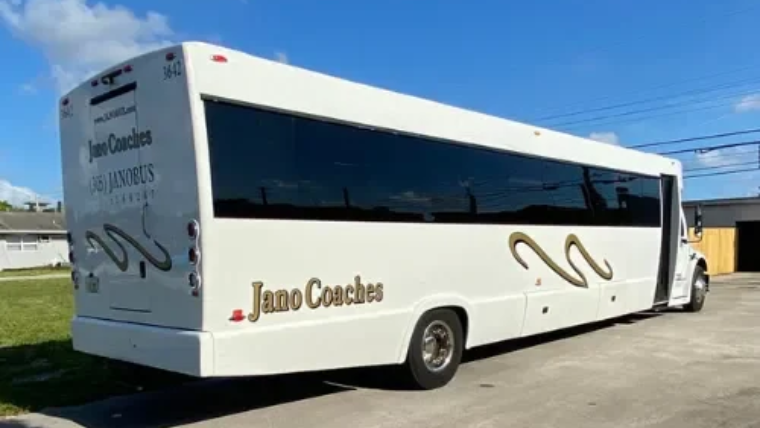
The go-to vehicle for larger church groups, big family reunions, and 50-passenger affinity cruises. Full undercarriage luggage bays typically handle one standard suitcase per passenger plus overhead storage for carry-ons. Onboard restroom on most models, reclining seats, climate control. For most 40-to-50-person group cruise transfers, this is the vehicle.
Multi-Vehicle Coordination (55+ Passengers)
Enterprise-scale group cruises require two or more coaches with staggered or parallel routing. Grade-wide family reunion cruises, large church-cruise charters, and multi-cabin alumni-group sailings all live in this tier. Routing and driver coordination affect both the price and the departure logistics, so raise it at the quote stage. See our full fleet for the vehicles we run across all four tiers, or the charter bus transportation page for the service overview.
If your group is small enough that you’re weighing a limo versus a party bus versus an SUV instead of a full charter bus, our vehicle choice guide helps work through that call.
When to Book Group Cruise Transportation
Charter bus availability in South Florida compresses hard during cruise peak season — November through May — and especially on holiday and spring break weekends when cruise, wedding, and corporate charter demand all land on the same operator at the same time. Here is what booking lead time looks like for group cruise transportation:
1. 90 to 120 days out: Large church groups and affinity-group cruises (50+ riders)Full-size motor coach availability compresses first. Statewide church-cruise charters, alumni-group cruises, and multi-cabin corporate incentive cruises all concentrate on the same winter and spring weekends. If your group is 50 or more, book the window the sail date is announced.
2. 60 to 90 days out: Family reunions and mid-size groups (20-50 riders)Mini-coach and full-size motor coach availability holds longer than the 55-passenger tier, but holiday weekends — Thanksgiving, Christmas, New Year’s, spring break — still tighten availability sharply. Lock in the vehicle before you lock in the final hotel block.
3. 30 to 60 days out: Small groups (12-20 riders)Sprinter and mini-coach availability is generally findable in this window outside of major holidays. During peak season holiday weekends, treat the smaller-vehicle market the same as the full-size market and book earlier.
4. Inside 30 days during peak season: Risk zoneSouth Florida cruise peak runs November through May. Inside 30 days during peak season means limited vehicle choice and premium pricing. Options exist, but the vehicle you want may not — and multi-hotel pickup requests become much harder to accommodate on short notice. If your group is still forming, lock the transportation anyway with your best headcount estimate; adjusting the vehicle up or down later is easier than finding one from scratch inside two weeks.
5. Book the return leg at the same timeDebarkation morning spreads a few thousand passengers off the ship across a two-to-three-hour window depending on cabin assignment and debarkation group. Your group of 40 will likely be spread across that window too. Pre-booking the round-trip arrangement at the same time as the pre-cruise transfer locks in the return vehicle and the meet-up point at the terminal, which beats booking the return separately after the cruise ends and competing with every other cruise party trying to do the same thing. If your group is still weighing which port makes more sense, our Port of Miami vs. Port Everglades comparison covers the embarkation and debarkation differences between the two.
Frequently Asked Questions About Group Charter Bus Transportation to Cruise Ports
Here are answers to common questions coordinators ask about chartering a bus for a group cruise from South Florida:
How much does charter bus transportation to Port of Miami cost for a group?
Group charter bus transfers to Port of Miami in the 2026 South Florida market are priced per vehicle, not per person. A full-size motor coach for a one-way local transfer typically runs in the several-hundred-to-roughly-one-thousand-dollar range, with mini-coaches lower and Sprinter vans lower still. Divide the total by the rider count to get the per-person math, which drops as the vehicle fills. Line items worth asking the operator to spell out include SunPass tolls, extended wait time, driver gratuity (industry norm is ten percent), and multi-hotel pickup fees.
Can one charter bus pick up multiple hotels before heading to the cruise port?
Yes. Multi-hotel pickup is a standard capability a reputable charter bus operator can arrange, with real time and cost implications worth raising at the quote stage. Each additional hotel typically adds ten to twenty minutes of loop time, and the coach still has to reach the port in time for the earliest check-in window in your group. For groups spread across more than three or four hotels, running two coaches on parallel pickup loops often beats one coach on a long single loop. Share your hotel list up front so the operator can map the pickup sequence against your boarding window.
What's the biggest group a single charter bus can handle for a cruise port transfer?
A standard full-size motor coach seats 45 to 56 passengers depending on the model, with undercarriage luggage bays that typically fit roughly one standard suitcase per passenger plus overhead storage for carry-ons. For a full 55-rider group each bringing a checked bag and a carry-on, that math gets tight — some operators recommend adding a Sprinter or mini-coach for luggage overflow. Groups above 55 riders move in multiple vehicles. Verify the specific coach’s passenger and luggage capacity with the operator when quoting, since specs vary by model year and manufacturer.
How far in advance should we book group transportation to a cruise port?
For large church groups and affinity-group cruises of 50 or more riders, book 90 to 120 days ahead. For family reunions and mid-size groups of 20 to 50, 60 to 90 days. For smaller groups of 12 to 20, 30 to 60 days. Lead time compresses noticeably during South Florida cruise peak season (November through May) and around major holidays and spring break weekends, when cruise and wedding charter demand hit the same operator at once. Booking inside 30 days during peak season routinely means limited vehicle availability and premium pricing.
What happens if our group's cruise embarkation times are staggered across different check-in windows?
Modern cruise lines space check-in by cabin assignment, so a 40-person group often has check-in windows that span two or more hours. The standard approach is to time pickup for the earliest check-in in the group plus a traffic buffer. Everyone arrives together; those with later windows wait in the terminal lounge or boarding area, and no one misses their window. A group member running significantly late is better served by rideshare backup than by delaying the entire bus. For individual-level embarkation timing — pre-boarding steps, luggage drop, and what to expect at the terminal — see our cruise embarkation day timeline guide for South Florida travelers.
Sailing with a Group from Port of Miami or Port Everglades?
Larry’s Private Car & Limousine has moved family reunions, church groups, and multi-cabin cruise parties to South Florida cruise ports for more than 30 years. Our fleet runs from executive Sprinters for small groups up through full-size motor coaches, and we’ll coordinate the pickup logistics so your group arrives at the port window when boarding is actually open.