
How to Rent a Charter Bus in South Florida: The Complete Group Transportation Planning Guide
Charter Bus Transportation · 9 min read
Planning transportation for a group can feel like a puzzle with a dozen moving pieces. You know you need to get everyone to the same place at the same time — but how big a vehicle do you need? What is it going to cost? How far ahead do you have to book, and what exactly are you paying for? If you have never arranged group transportation before, the questions pile up fast.
This guide walks you through all of it in plain language: how to tell when your group needs a dedicated vehicle, how to match your headcount to the right size (from an executive sedan to a 56-passenger motor coach), what affects the price, and the step-by-step process for booking with confidence. You will also find a few South Florida–specific tips that can save you real headaches on the day of your trip.
At Larry’s, we have been moving South Florida groups for more than 30 years, and we own every vehicle in our fleet — from sedans to full-size motor coaches. That means when you arrange a charter bus rental with us, you are working directly with the company that owns the bus, not a broker handing your trip off to a stranger. Here is everything you need to know to plan yours.
When Do You Need Group Transportation?
Not every group outing calls for a charter bus or shuttle — but plenty do. As a rule of thumb, once you are coordinating more than a handful of people heading to the same place at the same time, a dedicated vehicle beats a caravan of personal cars or a stack of rideshare requests. Here are the situations where South Florida groups most often book group transportation:
1. Corporate events and conferences
When your company hosts a conference, an off-site meeting, or a client event, transportation reflects directly on you. Keeping everyone on one vehicle means no stragglers, no parking headaches, and guests who arrive together and on time. If you are organizing something larger, our guide to planning corporate event transportation walks through the full logistics, and our corporate transportation service covers ongoing business needs.
2. Sports teams and stadium events
South Florida is packed with venues that draw a crowd, and game-day traffic is no place for a caravan of cars. Groups regularly book transportation to Hard Rock Stadium in Miami Gardens for Miami Dolphins games, University of Miami Hurricanes football, concerts, and major events like the 2026 World Cup; to Kaseya Center in downtown Miami for the Miami Heat; to Amerant Bank Arena in Sunrise for the back-to-back Stanley Cup champion Florida Panthers; and to LoanDepot Park for Miami Marlins baseball. One vehicle keeps your team, fans, or clients together and skips the scramble for parking and post-game rideshare surge pricing.
3. Weddings and guest transport
Wedding guest shuttles have become a South Florida standard. They keep guests from circling for parking, give everyone a safe ride between hotel, ceremony, and reception, and keep your timeline on track — and a shuttle or motor coach doubles as the designated driver for the whole party. Our wedding transportation service handles the vehicles, and our guide to planning wedding transportation walks through the full timeline.
4. School, church, and youth group trips
Field trips, band and choir travel, youth retreats, and campus outings all need safe, supervised transportation with room for gear. A professional driver and a single vehicle keep chaperones in one place and students accounted for from departure to return.
5. Family reunions and milestone celebrations
When relatives fly in from out of town for a reunion, a milestone birthday, or an anniversary, group transportation turns “how is everyone getting there?” into a non-issue. Everyone rides together, no one gets lost, and the celebration starts the moment the doors close.
6. Conventions and hotel shuttles
Conventions and multi-day events often need shuttle loops running between hotels and the venue. A dedicated vehicle on a set schedule keeps attendees moving without anyone hailing a separate ride or getting turned around in an unfamiliar city.
7. Airport group arrivals
When a group lands together at FLL, MIA, or PBI — a corporate team, a wedding party, a tour group — one vehicle with luggage space is far simpler than splitting into separate cars. Everyone clears the airport and heads to the destination together.
What Size Do You Need? Matching Your Group to the Right Vehicle
This is the question that trips up most first-time planners. The single most important factor is your headcount, but the type of trip matters too — a downtown dinner is different from a multi-day tour with luggage. Here is how the most common vehicle types break down by capacity and best use, from smallest to largest. When in doubt, size up: it is better to have a few empty seats than to leave people behind.
Luxury sedan or SUV (1–6 passengers)
Ideal for executives, couples, small families, and VIP airport runs. A sedan comfortably seats up to three with luggage; an SUV handles up to six. Quiet, discreet, and easy to maneuver — but not built for coolers, banners, or a big crew.
Sprinter or passenger van (7–14 passengers)
The sweet spot for small groups: wedding parties, corporate teams, and group airport transfers. A Sprinter offers stand-up headroom and room for bags, keeping 7 to 14 people together without jumping to a full-size bus.
Minibus or mini-coach (15–28 passengers)
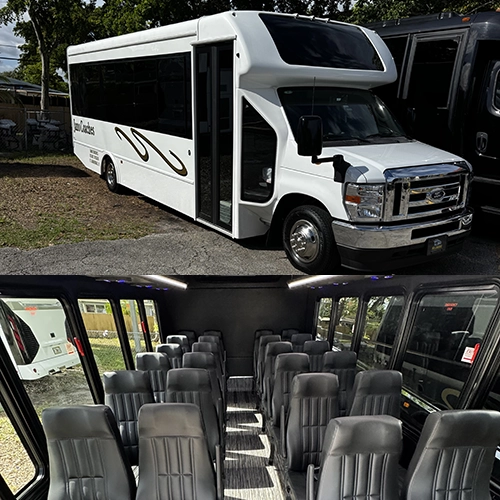
The bridge between a van and a full motor coach. Minibuses typically seat anywhere from about 15 to 28 (some configurations run to 35) and are easy to position at hotels and tight urban venues — a strong fit for team transport, hotel-to-venue shuttles, and mid-size tours.
Charter bus or motor coach (30–56 passengers)
What most people picture when they think “charter bus.” A full-size motor coach most commonly seats 56, with configurations ranging from roughly 36 up to 60 depending on the model. These are built for large groups and longer distances, with reclining seats, overhead and under-coach storage, and often a restroom and entertainment system. Keep in mind that an onboard restroom takes up the space of about four seats, and wheelchair-accessible layouts reduce the count slightly — so confirm the real capacity of the specific vehicle when you book. You can see the full range on our fleet page, or learn more about group transportation services for larger events.

Not Sure Which Vehicle Fits Your Group?
Tell us your headcount, date, and route, and we will recommend the right vehicle and send a custom quote — no guesswork, and no paying for seats you will not fill.
How Much Does It Cost to Rent a Bus?
There is no single sticker price for group transportation, and any provider who quotes you a flat number before asking about your trip is guessing. Cost comes down to a handful of factors, and once you understand them, the quotes you receive will make a lot more sense.
How providers price the trip. Most group transportation is billed one of three ways: by the hour (with a typical two-to-three-hour minimum), at a flat point-to-point rate for a set route, or by the day for longer charters. Hourly works best when your schedule is flexible or has multiple stops; flat rates suit a straightforward there-and-back; daily rates apply to multi-day trips.
What moves the price. The biggest drivers are vehicle size (a motor coach costs more than a minibus, but splits across more people), distance and duration, and timing. Like hotels and flights, group transportation has busy seasons — weekends, holidays, graduation and wedding season, and major event dates all command higher rates, while weekday and off-season trips cost less. Amenities such as restrooms, WiFi, and upgraded seating can add to the base rate, and you are typically responsible for tolls, parking, and, on overnight trips, the driver’s lodging. Gratuity is customary as well.
Why per-person cost is the number that matters. A charter bus can look expensive as a lump sum, but divide it across 40 or 50 passengers and it often costs less per person than everyone driving and parking separately — and it is far more convenient. When you compare quotes, look at the per-person cost, not just the total.
Why quotes vary between providers. Here is the part most people do not know: many companies that advertise charter buses are brokers who do not own a single vehicle. They take your booking, mark it up, and subcontract the trip to whichever operator they can find — part of why local operators that own their fleets often come in lower than national booking sites. When you book your charter bus rental directly with the company that owns and maintains the vehicle, you get one accountable point of contact and no middleman markup. It is worth asking any provider whether they own their fleet or farm it out.
How to Book Group Transportation: A Step-by-Step Guide
Once you know what size vehicle you need, booking is straightforward. Having a few details ready before you reach out makes the quote faster and more accurate. Here is the process from start to confirmation:
1. Lock in your headcount
Get as firm a number as you can, including any chaperones, guests, or likely last-minute additions. Your headcount determines the vehicle, and undershooting it is the most common booking mistake — it leaves you scrambling for a second vehicle later, often at a higher rate.
2. Confirm your date, times, and route
Have your date, pickup time, pickup and drop-off locations, and any stops along the way. For events, know your venue and whether you will need the vehicle to wait on site or make a separate return trip.
3. Note any special requirements
Flag anything that affects the vehicle: wheelchair accessibility, significant luggage or equipment, car seats, or onboard amenities like a restroom or WiFi for a long trip. Mentioning these up front ensures the right vehicle is assigned the first time.
4. Request a detailed quote
Reach out with your details and ask for an itemized quote. A good quote spells out the vehicle, the hourly or flat rate, and what is included — so you are comparing apples to apples between providers.
5. Vet the provider before you commit
Confirm the company is properly licensed and insured, ask whether they own their fleet or subcontract, and check that gratuity, fuel, and tolls are either included or clearly listed. Watch for red flags like vague pricing, no written confirmation, or pressure to pay in full up front with no contract.
6. Get it in writing and book early
Confirm everything in writing before you pay. For lead time, a few weeks is usually enough for a small, simple trip, but large groups, peak season, and multi-day charters are best booked three to six months ahead to lock in your vehicle and the best rate. When you are ready, you can request a quote or call to confirm your booking.
Frequently Asked Questions About Renting a Charter Bus
Here are answers to the questions South Florida groups ask most often when planning a charter bus rental:
Do charter buses have bathrooms?
Most full-size motor coaches have an onboard restroom, which is one reason they are the go-to choice for long-distance trips. Minibuses, Sprinter vans, and smaller vehicles typically do not, since they are built for shorter routes. If a restroom matters for your trip, confirm it when you book, and remember that an onboard restroom slightly reduces the number of seats.
Do charter buses have outlets and WiFi?
Power outlets and USB ports are standard on most full-size charter buses, and many offer WiFi as well, though WiFi is sometimes available only on request or for an added fee. Amenities vary by vehicle and provider, so ask what a specific bus includes if staying connected is important for your group.
How much should I tip a charter bus driver?
A gratuity of roughly 10 to 15 percent of the total fare is customary for charter bus and motor coach drivers, though it is always at your discretion based on the service. Some quotes include gratuity automatically, so check your itemized quote first to avoid tipping twice.
How far in advance should I book a charter bus?
For a small, simple trip, a few weeks is often enough. For large groups, peak travel seasons, holidays, and multi-day charters, booking three to six months ahead is recommended to secure your preferred vehicle and the best rate. The earlier you book, the more options you will have, and last-minute requests can often still be accommodated when vehicles are available.
Are charter buses wheelchair accessible?
Yes. Wheelchair-accessible vehicles with lifts or ramps and securement systems are available, and there is usually no extra charge for accessibility. Because accessible vehicles are a limited part of any fleet, give your provider as much advance notice as possible so the right vehicle can be reserved for your trip.
Ready to Book Group Transportation in South Florida?
For more than 30 years, South Florida groups have trusted Larry’s to get everyone where they need to be — together, on time, and without the stress. Because we own every vehicle in our fleet, from executive sedans to 56-passenger motor coaches, there is no subcontracting and no middleman: one accountable point of contact handles your entire group from the first quote to the final drop-off.
Tell us your headcount, date, and route, and we will recommend the right vehicle and send you a custom quote. Whether it is a wedding, a corporate event, a team trip, or a family reunion, we will make the transportation the easy part.