
30+ Years of Luxury Chauffeur Limousine Transportation Excellence Across South Florida

What Time to Arrive at Port of Miami for Your Cruise: Embarkation Day Timing for South Florida Sailings

Cruise Port Transportation · 10 min read

Your cruise is booked. You know the ship, the cabin, and the sail date. What you probably haven’t nailed down yet is the ground logistics of embarkation day — what time to leave the hotel, when to arrive at the port, how early is too early, and what actually happens between the terminal drop-off zone and the moment you step onto the ship.

Port of Miami and Port Everglades move more cruise passengers than almost any other ports in the world, and both run on tight embarkation schedules. The difference between arriving at the right moment and arriving at the wrong one is usually the difference between a smooth start to your trip and an hour-plus wait with your luggage on the sidewalk.

This guide walks through the day-of timing framework for sailings from either South Florida port — the three times that actually matter, when to leave your hotel or the airport, what the embarkation process looks like, and the pre-leave checklist. When you’re ready, Larry’s provides private cruise port transportation across South Florida with chauffeurs who know every terminal, drop-off zone, and traffic pattern between Palm Beach and Miami-Dade.

Cruise Embarkation Day at Port of Miami and Port Everglades: What to Expect

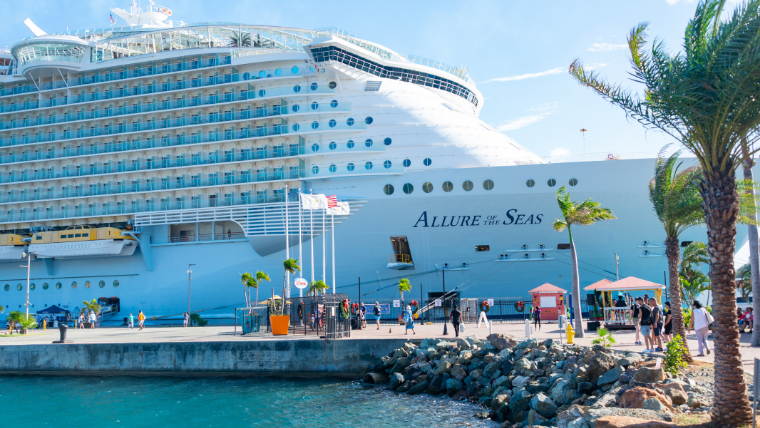
Royal Caribbean cruise ship docked at cruise port terminal with palm trees and passengers on pier

Both Port of Miami and Port Everglades handle multiple ships per day throughout cruise season — November through April is the heaviest window, and Saturdays and Sundays are the peak embarkation days at either port. On a busy weekend, Port of Miami can have five or six ships loading passengers at the same time across its terminals, with thousands of travelers moving through security, check-in, and boarding in overlapping waves. Port Everglades runs on a similar scale, with its own cluster of terminals handling Caribbean, Panama Canal, and transatlantic departures.

First-time cruisers are frequently surprised by the sheer scale of the operation. These are not small, quiet terminals — they are major transportation hubs with coordinated traffic flow, dedicated drop-off zones, porter stations, security checkpoints, and multi-level boarding gates. The upside: everything runs on a schedule, and if you arrive at the right time, the process moves efficiently. The downside: showing up at the wrong time means either waiting outside with your luggage or sitting in a long queue that moves slowly.

The two ports have operational differences that affect embarkation day timing — different terminal layouts, different drop-off zones, different parking configurations, and sometimes meaningfully different security throughput. For the full breakdown, see our full comparison of Port of Miami and Port Everglades. For purposes of day-of timing, the short version is that both ports open to passengers in staggered waves tied to check-in appointments, and both strictly enforce their all-aboard times.

The Three Times That Matter: Check-In, Boarding Start, All-Aboard

Three different times appear on and around your cruise confirmation documents, and they mean different things. Confusing them is the most common source of day-of timing stress. Here is how to read each one.

Check-In Appointment

This is the time slot assigned to you by the cruise line, usually visible in your SetSail Pass, eDocs, or the cruise line’s app after online check-in. Most cruise lines sailing from South Florida space check-in appointments between roughly 10:30 AM and 2:30 PM in 30-minute windows to control crowd flow. Treat this time as the target — plan to arrive at the terminal within your assigned window, not before and not after.

Boarding Start Time

This is when the ship itself opens to the first passengers, generally 10:30 AM to noon on standard sailings. Boarding then rolls through the day in groups until all check-in windows have passed. Your check-in appointment and the boarding start time are not the same thing — if your check-in is 1:00 PM, you are not expected at the terminal when boarding opens at 10:30 AM. Showing up that early typically means standing outside the terminal until your window arrives.

All-Aboard Time

This is the hard deadline — the last moment you can be onboard before the ship closes its gangway and prepares to sail. All-aboard is typically set 60 to 90 minutes before the scheduled departure time. Cruise lines strictly enforce this deadline because the ship must leave the port on schedule for its next itinerary. Missing all-aboard means watching the ship pull away from the terminal with your cabin on it — and arranging your own travel to the next port of call if you want to rejoin the cruise.

When to Leave Your Hotel: Timing by South Florida County

Drive times between South Florida hotels and the two cruise ports vary significantly by county and traffic. The ranges below assume standard weekend morning traffic — add 15 to 30 minutes for weekday rush hours or if a major event is pushing I-95 traffic. Add another 30 to 45 minutes on top of the drive time for terminal entry, porter luggage drop, and the walk from drop-off to check-in. For hotel-shopping readers, see our guide to hotels near Miami cruise port with shuttle service.

1. Miami-Dade Hotels to Port of Miami

Downtown Miami, Brickell, and South Beach hotels are typically 15 to 30 minutes from Port of Miami in standard traffic. Hotels in Doral, Coral Gables, and the airport area run 25 to 45 minutes. Add 10 to 20 minutes if your cruise sails on a Saturday morning when inbound port traffic peaks.

2. Miami-Dade Hotels to Port Everglades

Miami-Dade hotels heading north to Port Everglades generally run 40 to 75 minutes depending on your starting point and I-95 conditions. Doral and the airport corridor sit at the shorter end; South Beach and the southern parts of the county fall at the longer end. A backup on I-95 northbound can add 20 to 40 minutes with little warning.

3. Broward County Hotels to Port Everglades

Fort Lauderdale beach hotels, downtown Fort Lauderdale, and most of eastern Broward sit 10 to 25 minutes from Port Everglades in standard conditions. Hotels in western Broward (Plantation, Sunrise, Weston) typically run 25 to 45 minutes. Port Everglades is the easiest cruise port in South Florida to reach from a Broward hotel.

4. Broward County Hotels to Port of Miami

Broward hotels heading south to Port of Miami generally run 35 to 70 minutes depending on where in the county you are starting and I-95 southbound conditions. Fort Lauderdale beach to Port of Miami is routinely in the 45-to-60 minute range in standard traffic, longer during peak hours.

5. Palm Beach County Hotels to Either Port

Palm Beach County hotels — Boca Raton, Delray Beach, West Palm Beach — run 45 to 90 minutes to either South Florida cruise port depending on exact location and traffic. Palm Beach to Port Everglades is the shorter route; Palm Beach to Port of Miami runs toward the longer end. Snowbird cruisers routinely build in extra buffer on this leg.

When to Leave the Airport: FLL and MIA to the Ports on Cruise Day

Flying in the same day as a cruise departure is high-risk by nature — any flight delay, missed connection, baggage issue, or ground traffic snag can cost you the sailing. Most cruise lines explicitly discourage day-of flights and recommend arriving a day early. If you must fly in on cruise day, the ranges below reflect standard conditions with the full buffer math built in. For the complete framework, see our complete guide to airport-to-cruise-port transfers, and when you need polished airport transportation to tie it together, Larry’s handles both legs for cruise travelers daily.

1. FLL to Port Everglades

Fort Lauderdale-Hollywood International Airport sits about 3 miles from Port Everglades — a 10 to 20-minute drive in standard traffic. This is the single easiest airport-to-port transfer in South Florida, which is why FLL is the preferred fly-in airport for Port Everglades sailings. Even accounting for deplaning, baggage claim, and ground transfer, you can land at FLL by 9:30 AM and reasonably make a standard 1:00 PM check-in.

2. FLL to Port of Miami

FLL to Port of Miami runs 30 to 60 minutes depending on I-95 southbound traffic. Day-of cruise travelers flying into FLL for a Port of Miami sailing should plan for a landing time of no later than 10:00 AM for a standard afternoon cruise departure. The I-95 southbound stretch is unpredictable enough that building in a cushion matters more than squeezing the margin.

3. MIA to Port of Miami

Miami International Airport is 15 to 30 minutes from Port of Miami in standard conditions — slightly closer than FLL to Port Everglades in geographic terms but with heavier urban traffic. Day-of fly-in travelers landing at MIA for a Port of Miami cruise can target an 11:00 AM landing for most afternoon sailings. MIA’s baggage claim can be slow during peak international arrival banks, which adds variability.

4. MIA to Port Everglades

MIA to Port Everglades runs 40 to 75 minutes depending on I-95 northbound conditions — a meaningfully longer and more variable transfer than FLL to Port Everglades. Day-of cruisers landing at MIA for a Port Everglades sailing should plan for a 9:00 to 9:30 AM landing to leave adequate buffer. If both airports are options, FLL is almost always the better choice for Port Everglades departures and MIA is marginally better for Port of Miami departures.

Port of Miami vs. Port Everglades: Operational Differences That Affect Timing

From an embarkation timing standpoint, the two ports behave similarly on the surface — both open to passengers in staggered waves, both run porter stations outside the terminals starting a few hours before boarding opens, both route traffic through designated cruise terminal drop-off zones. The operational differences that actually affect your day-of timing live in the details.

Port of Miami’s cruise terminals cluster on Dodge Island, connected to downtown Miami by Port Boulevard and the MacArthur Causeway. Drop-off traffic typically funnels through a single entry road and distributes to the individual terminals, which means on peak weekend mornings the entry queue itself can add 10 to 20 minutes before you reach the drop-off zone. Port Everglades runs multiple terminal clusters with their own entry roads, which generally distributes drop-off traffic more smoothly on peak days.

Terminal check-in throughput varies ship-by-ship and depends on which cruise line’s terminal you are sailing from — some lines have invested in faster boarding tech than others. Either way, build in the 30-to-45-minute terminal buffer on top of your drive time, and expect the longer end on peak departure days. For the complete port comparison including terminal assignments and parking details, see our full comparison of Port of Miami and Port Everglades.

Lock in your embarkation day pickup

Once your timing is set, book your ride to the port with a provider that understands cruise embarkation schedules. Larry’s has handled South Florida cruise port transfers for over 30 years — chauffeurs who know the terminal drop-off zones, the peak traffic windows, and how to time pickup so you arrive when the ship actually wants you there.

The Embarkation Process Once You Arrive

From the moment your vehicle pulls into the terminal drop-off zone, embarkation moves through a sequence of steps that typically takes 45 to 90 minutes end-to-end — longer on peak departure days when security and check-in queues stretch. Here is what happens, in order.

1. Terminal Drop-Off (5 to 10 minutes)

Your vehicle pulls into the designated cruise terminal drop-off zone, luggage comes out of the trunk, and you move to the sidewalk. If you drove yourself and need to park, this step takes 20 to 40 minutes longer depending on which lot you use and how far it is from your terminal.

2. Porter Luggage Handoff (5 to 10 minutes)

Porters stationed outside the terminal accept your checked luggage, tag it with your cabin number (your cruise documents will instruct you to pre-tag your bags), and route it to the ship for delivery to your cabin later in the day. Tipping porters is customary — generally $1 to $2 per bag.

3. Terminal Entry and ID Check (5 to 15 minutes)

You enter the terminal building, present your cruise documents and government-issued photo ID (passport for most international itineraries), and move toward the security screening area. On peak days this is often where the first noticeable queue forms.

4. Security Screening (10 to 20 minutes)

Carry-on bags go through X-ray, passengers walk through metal detectors, same as airport-style TSA screening. Cruise security is generally less strict than airport TSA — you do not need to remove shoes or liquids — but on peak days the queue itself can be substantial.

5. Cruise-Line Check-In and SeaPass (10 to 20 minutes)

At the cruise line’s check-in counter, agents verify your reservation, confirm your credit card on file for onboard purchases, and issue your SeaPass or boarding card. This step moves faster if you completed online check-in in advance.

6. Boarding Photo (2 to 5 minutes)

The cruise line takes a quick embarkation photo of your group as you move toward the gangway. These photos are made available for purchase onboard — no obligation.

7. Walking the Gangway (5 to 10 minutes)

You walk through the final boarding gate, cross the gangway, and step onto the ship. A crew member scans your SeaPass to officially check you in. From here, your cabin may or may not be ready — ship amenities are open, and lunch service is almost always running by this point in the day.

How Early Is Too Early — and What Happens If You’re Late

Timing an embarkation day well means hitting a window — not showing up as early as possible and not cutting it close. Both extremes have real costs.

Arriving three or more hours before your assigned check-in window usually means waiting outside the terminal with your luggage. Cruise terminals do not open to passengers simply because the clock reads 7:00 AM — they open in waves tied to boarding start time and the check-in schedule. If you show up at Port of Miami at 8:30 AM for a 1:00 PM check-in appointment, you will stand on the sidewalk with your bags until the terminal starts admitting your wave. Porters may accept your luggage once their stations open, but that does not get you inside.

Arriving after all-aboard means the ship sails without you. This is not a figure of speech — cruise lines must leave the port on schedule for their next itinerary, and they will close the gangway and pull away from the terminal with your cabin aboard. The industry-standard policy for a missed sailing is that you are responsible for your own travel to the next port of call, with no refund for the leg you missed. All-aboard is set 60 to 90 minutes before departure specifically so the ship has time to secure its gangway, finalize its manifest, and leave on time.

The sweet spot: aim to arrive at the terminal 60 to 120 minutes before your assigned check-in appointment. That window gets you through porter handoff, security, and check-in with reasonable buffer, and lands you aboard the ship in time for lunch and a relaxed first look at your cabin area without burning hours at a drop-off zone.

Day-of Embarkation Checklist

Before you leave the hotel, confirm each of the following. The ones that trip cruisers up are rarely the obvious ones — it is the credit card, the pre-tagged luggage, and the realistic buffer time that get overlooked under morning-of pressure.

Cruise Documents

Printed or screenshotted SetSail Pass, eDocs, or cruise-line app with your boarding information loaded. Have the documents accessible on your phone and in paper form as a backup — terminals are not reliable spots for a dead battery or no-signal recovery.

IDs and Passports for Everyone in the Group

Government-issued photo ID for every passenger. A passport for closed-loop sailings is strongly recommended even when technically not required, and a passport is mandatory for most non-Caribbean itineraries. Children’s documentation requirements vary — check your cruise line’s specific policy well before departure day.

Credit Card on File with the Cruise Line

The card that will cover your onboard account for the entire voyage. Most cruise lines ask you to confirm this card at check-in, and some place an initial authorization hold. Make sure the card you plan to use has adequate available credit and is active for travel.

Carry-On with First-Day Essentials

Checked luggage dropped with porters at the terminal is delivered to your cabin later in the afternoon — sometimes not until early evening. Pack a day bag with medications, a change of clothes, swimwear, sunscreen, phone chargers, and anything else you will want in the first few hours onboard.

Luggage Pre-Tagged with Your Cabin Number

Most cruise lines send luggage tags with cabin numbers printed on them as part of your pre-sail documents, or make them available to print at home. Attach tags to each piece of checked luggage before you leave the hotel — porters move faster when the tags are already on, and your bags get to your cabin faster.

Transportation Confirmed

Pickup time, pickup address, destination terminal, and driver contact information verified the night before. For families with young children, also see our family car service guide for notes on child seats and group vehicle sizing — Larry’s runs executive sedans and SUVs suited to different group and luggage configurations.

Buffer Time Added

Add 15 to 30 minutes to whatever your calculated departure time is. Something will take longer than expected — a slow elevator, a traffic incident, a last bag that needs repacking. Buffer time is what separates a smooth embarkation day from a rushed one.
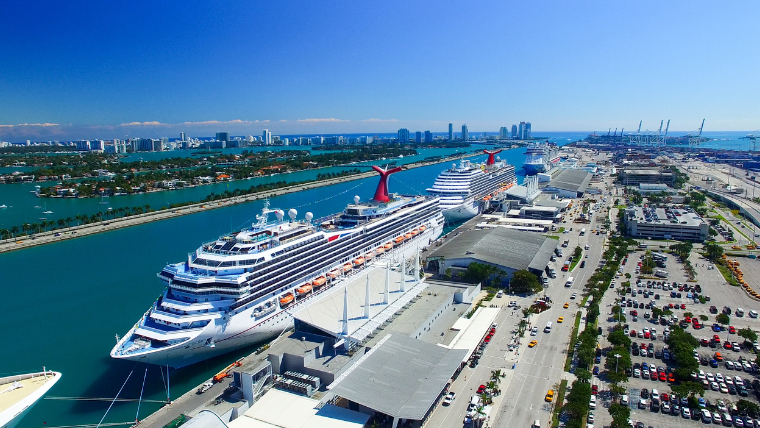
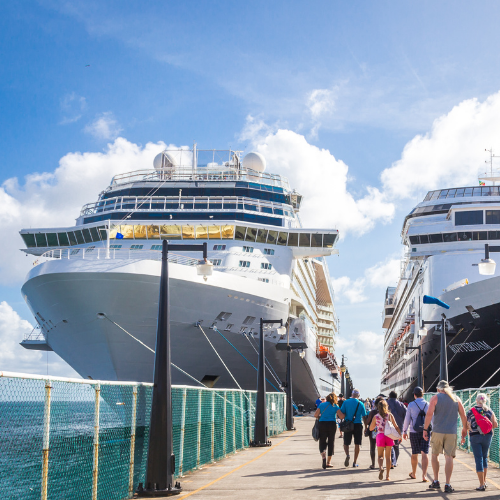
Aerial view of cruise ships docked at Port Miami with cruise terminals and parking areas

Frequently Asked Questions About Cruise Embarkation at South Florida Ports

Here are answers to common questions travelers ask about cruise embarkation at Port of Miami and Port Everglades:

What time should I arrive at Port of Miami or Port Everglades for my cruise?

Plan to arrive 60 to 120 minutes before the check-in appointment time printed on your cruise confirmation documents. Most cruise lines sailing from South Florida assign check-in windows between 10:30 AM and 2:30 PM. Arriving earlier than 60 minutes before your window usually means waiting outside the terminal with your luggage; arriving later risks missing your assigned slot and getting bumped to a longer general queue.

Boarding typically starts between 10:30 AM and noon on most sailings from Port of Miami and Port Everglades, though cruise lines open their terminals in staggered waves tied to each passenger’s check-in appointment. You can arrive at the port earlier than your assigned window, but most terminals do not admit passengers until roughly 30 to 60 minutes before their check-in time, and the ship itself usually opens to the first boarding group around 10:30 AM to noon.

The ship sails without you. All-aboard time is a hard deadline, typically set 60 to 90 minutes before the scheduled departure, and cruise lines strictly enforce it because the ship must leave the port on schedule for the next itinerary. Missing all-aboard means you forfeit that leg of your cruise and are responsible for your own travel to the next port of call if you want to rejoin the ship.

Plan on 45 to 90 minutes from the time your vehicle reaches the terminal drop-off zone to the moment you walk onto the ship. The process includes porter luggage handoff, terminal entry and ID check, security screening, cruise-line check-in with your SeaPass or boarding card, the boarding photo, and the walk down the gangway. On peak departure days — especially Saturdays and Sundays in cruise season — the security and check-in queues can push total time toward the longer end of that range.

Most cruise lines strongly discourage same-day flights because any delay in your arrival — a missed connection, cancelled flight, baggage delay, or traffic between the airport and the port — can cause you to miss the ship entirely. If you must fly in day-of, book the earliest flight available and arrive at FLL or MIA no later than 10:00 AM for a standard afternoon sailing.

Sailing from Port of Miami or Port Everglades?

Larry’s Private Car & Limousine provides private cruise port transportation across South Florida — hotel-to-port, airport-to-port, home-to-port — with chauffeurs who know every cruise terminal, drop-off zone, and traffic pattern between Palm Beach and Miami-Dade. You get picked up at the right time, assistance with luggage, and arrival at the port window when boarding is actually open.