
How to Coordinate Wedding Transportation Across Multiple Venues in South Florida
Wedding · 12 min read
Wedding transportation is often planned like a shopping list — book a limo for the bridal party, arrange a shuttle for guests, done. That framing hides the real problem. A wedding day involves multiple pickup points, multiple time windows, multiple guest tiers, and a timeline that moves faster than any other event you will host. The vehicles are the easy part. Coordinating them is the hard part.
After 30+ years coordinating South Florida weddings — from intimate 40-guest beach ceremonies to 300-guest multi-hotel destination weekends across Broward, Miami-Dade, and Palm Beach — the same coordination scenarios come up over and over. This guide walks through the three that define most weddings, the timeline math that keeps them on schedule, the guest-count math that decides what vehicles you actually need, and the mistakes that turn a smooth day into a stressful one. For the broader planning foundation, see our complete wedding transportation planning guide. What follows drills into coordination specifically.
The Three Coordination Scenarios Every South Florida Wedding Faces

Almost every wedding coordination challenge is a variation on three scenarios. Most weddings involve at least two of them. Understanding each one — and how they combine — is what separates a transportation plan that works from one that unravels at 4 p.m. on the wedding day.
Scenario 1: Ceremony and Reception at Different Venues
The most common coordination challenge and the one couples underestimate most often. If your ceremony ends at 5:30 p.m. and cocktail hour at the reception venue starts at 6:00 p.m., you have 30 minutes to move every guest from one location to the other. That sounds simple until you factor in guest boarding time, drive time with peak-hour cushion, unloading time, and the two or three guests who inevitably need an extra five minutes.
The rule we use is last-guest-out to first-guest-in-plus-15. Your shuttle needs to depart the ceremony venue after the last guest has boarded (not the first) and arrive at the reception with at least 15 minutes of buffer before cocktail hour officially opens. That buffer covers late boarding, traffic surprises, and the reception venue’s own setup rhythm.
Cocktail hour is your best friend here. A properly planned 60-minute cocktail hour gives the shuttle time to complete the transfer and gives late guests a 30-minute grace window before they would notice they missed anything. If you are skipping cocktail hour or compressing it to 30 minutes, your transportation timing becomes far less forgiving. We usually recommend against it for exactly this reason.
For the late-guest contingency, keep one vehicle on standby at the ceremony venue for 20 minutes after your main shuttle departs. It handles guests who slip out to their car for a phone charger, guests who stop for photos, and the occasional guest who was in the restroom during boarding. A second-run vehicle is a small line item that prevents a big problem.
Scenario 2: Guests Spread Across Multiple Hotels
Destination weddings and out-of-town-heavy weddings almost always involve guest lodging distributed across three to eight hotels. This is standard across South Florida, where wedding parties book a mix of beach resorts in Fort Lauderdale or Miami Beach, boutique hotels near the venue, and airport-adjacent options for early departures. The coordination challenge is getting all these guests to the ceremony on time without a two-hour convoy of individual pickups.
Two strategies work. Consolidation points ask guests to walk or short-Uber to a single lobby, and the coach picks up from that one location. This is the cleanest option — one vehicle, one time window, one route. It works when guests are staying at hotels within a five-minute walk of each other or when one hotel is designated as the pickup hub.
The other strategy is door-to-door pickup, where the coach makes a loop through each hotel on a scheduled route. This works for three to five hotels within a compact geographic area. Beyond five hotels — or across more than a 10-mile spread — the route time destroys your ceremony timeline. For those weddings, we usually run two coaches on parallel routes rather than one coach on a longer loop. Learn more about wedding guest shuttle service options for larger group coordination.
Communication is what makes either strategy work. Every guest needs the pickup location, the exact pickup time, and a written reminder that the coach will not wait past the scheduled departure. The wedding website transportation tab, a group text 48 hours before, a printed card in the welcome bag, and a lobby sign at each hotel are all worth doing. Redundancy is not overkill on a day this coordinated.
Scenario 3: The Bridal Party on a Separate Track from Guests
The bridal party’s timeline almost never matches the guest timeline. Hair and makeup start hours earlier. The couple may want a first-look photo shoot at a scenic location before the ceremony. The photographer needs travel time between locations. Family portraits often happen at a third site. Meanwhile, the general guest shuttle is moving on its own clock.
The mistake here is trying to use one vehicle for both tracks. The bridal party needs a vehicle that stays with them for hair-and-makeup pickup, ceremony transport, photo transport, and reception arrival — a stretch limousine, a Sprinter van, or two SUVs depending on party size. That vehicle is a dedicated asset for the entire day. The guest shuttle is a separate vehicle on its own route and schedule.
The exception is smaller weddings where the bridal party and immediate family together fit in a single coach with the guests. If your ceremony has 30 guests total and one shuttle handles everyone, the separate-track logic does not apply. But once your party grows past 60 total guests, or your bridal party is doing pre-ceremony photos elsewhere, plan two vehicles from the start.
The Timeline Math: Working Backward from Ceremony Start
Every wedding transportation timeline is a subtraction problem. Start with the moment the ceremony begins, then work backward through every step that has to happen before it. The math is straightforward once you commit to writing it down. Skipping any of these steps is how weddings run 20 minutes late before anyone realizes the shuttle has not left yet.
1. Fix your ceremony start time
This is your anchor. Every other timing decision is calculated from here. If your ceremony starts at 5:30 p.m., that is not when you want guests arriving — that is when you are standing at the altar. Guests need to be seated before then.
2. Subtract the guest seating buffer
Guests need 15 to 20 minutes between arrival and ceremony start to find their seats, greet other guests, and be settled when the processional begins. For a 5:30 p.m. ceremony, the last guest should be inside the venue by 5:15 p.m., ideally 5:10 p.m.
3. Subtract the shuttle arrival window
Your shuttle should arrive at the venue with all guests aboard by 5:10 p.m. But it cannot pull up at exactly 5:10 p.m., unload 40 guests in one minute, and be done. Guests exit a motor coach at roughly one passenger every three seconds, so a 40-passenger coach needs 2 to 3 minutes of unloading time — call it 5 minutes with buffer. Shuttle arrival at venue: 5:05 p.m.
4. Subtract the drive time with a peak-hour cushion
Look up the drive time between pickup location and venue in Google Maps at the actual departure time you are planning, on the actual day of the week. South Florida traffic on a Saturday afternoon in season is not the same as a Tuesday at 10 a.m. Whatever Google shows, add 20 percent for a Saturday wedding between November and May. If the drive is 25 minutes, plan 30. Departure from hotel pickup: 4:35 p.m.
5. Subtract the shuttle loading window
Loading 40 guests onto a motor coach takes longer than unloading — roughly 5 to 7 minutes for a single pickup point, longer for door-to-door across multiple hotels. Plan a 10-minute loading window at a minimum. The coach needs to arrive at the pickup location by 4:25 p.m.
6. Subtract the pickup arrival buffer
The coach should arrive at the hotel 5 minutes before the scheduled pickup time so guests waiting in the lobby see the vehicle when they expect it. Coach arrival at hotel: 4:20 p.m. That means guests need to be in the lobby by 4:20 p.m., which means the pickup notice sent to guests should read “Meet in the lobby by 4:15 p.m. Coach departs at 4:25 p.m. sharp.” Never publish a single time — always give a lobby time and a departure time.
Run the same subtraction in reverse for the reception departure. The last-guest departure time from the reception is the anchor; work backward through end-of-night loading time, transit, and hotel arrival. Skip this and guests wait in an empty parking lot at midnight — the fastest way to end a great wedding on a sour note. For end-to-end professional wedding transportation, this math gets built into your day-of run sheet before the first vehicle moves.
Wedding Logistics, Handled.
Every wedding is a coordination puzzle — venue access, guest pickups, timeline math. We have been solving South Florida wedding transportation for 30+ years. Tell us what you are planning and we will build the transportation piece around it.
Vehicle Sizing by Guest Count
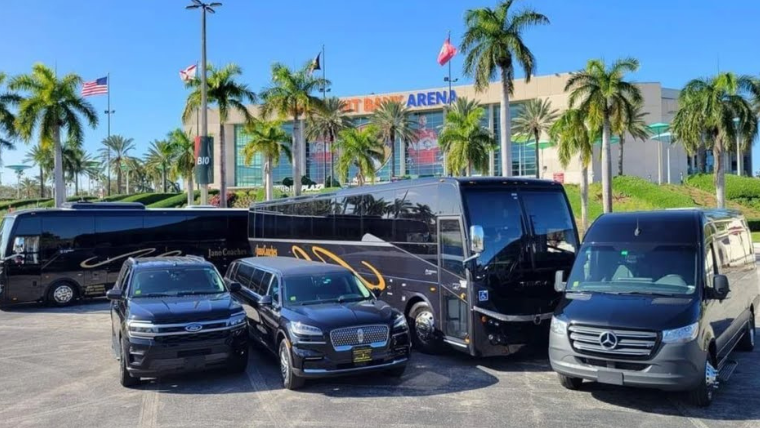
Vehicle count and vehicle type are downstream decisions from guest count and coordination scenario. Once you know how many guests need transportation and where they are coming from, the fleet math becomes straightforward. These are the four tiers we use to size wedding transportation across South Florida. For a deeper look at the vehicle types themselves, see our vehicle selection guide or browse our full fleet.
 Under 30 Guests: Single Executive Sprinter or Mini-Coach
Small ceremonies fit comfortably in one vehicle. An executive Sprinter van seats 10 to 14 passengers with luxury finishes; a mini-coach seats up to 24. One vehicle handles pickup, ceremony transport, and reception return without staggering runs.
30 to 55 Guests: Single Motor Coach
A standard motor coach seats 40 to 55 passengers. Fits the majority of mid-sized weddings on a single vehicle, single run. Add a dedicated executive sedan or SUV for the bridal party, kept separate from the guest coach.
55 to 110 Guests: Two Motor Coaches or Coach Plus Mini-Coach
Once you cross 55 guests, one vehicle either cannot fit everyone or runs so slow that timing suffers. Two coaches on staggered routes solve both problems. If your guest lodging is split between two hotel hubs, run one coach from each. Learn more about group vehicle options on our charter bus service page.
110+ Guests: Multi-Coach Coordination with a Dispatch Point
Large weddings need a coordinator on the transportation side, not just the wedding side. Three or more coaches running parallel routes require someone tracking each vehicle’s status, adjusting for delays, and communicating with the venue about arrival timing. This is where a professional operator earns their fee.
Book vehicles 6 to 9 months out for a peak-season wedding in South Florida (November through May) and 3 to 4 months out for off-season. Motor coaches for Saturday weddings during the December-through-April window book out especially fast — the earlier the better.
The Five Most Common Wedding Transportation Mistakes
Every wedding transportation problem we have seen in 30+ years fits into one of these five patterns. None of them are exotic. All of them are preventable if you know they exist before you book.
1. Underestimating Loading and Unloading Time
The most common mistake and the easiest to fix. Couples plan the drive time between locations but forget that 40 guests take 5 to 7 minutes to board and 2 to 3 minutes to disembark from a motor coach. Multiply that across a wedding day with three or four vehicle movements and you have lost 30 minutes to boarding math nobody accounted for. Build boarding time into your timeline as its own line item.
2. Single-Vehicle Routing for 60+ Guests
Trying to serve a 70-guest wedding with one 55-passenger coach seems logical until you realize the coach either cannot fit everyone (leaving 15 guests stranded) or needs to make two runs (adding 45 minutes to the schedule). Cross the 55-guest threshold and you are running two vehicles. There is no middle option that works.
3. No Plan for the Last Hour
Couples plan meticulously for the ceremony and reception arrival. Almost nobody plans the departure. Guests leave receptions at wildly different times — a wave at 9:30 p.m., another at 10:30 p.m., stragglers at midnight. Scheduling one return shuttle at 11 p.m. and expecting everyone to leave together is how you end up with 12 guests waiting in a parking lot at 12:15 a.m. Plan two or three return runs, staggered across the last two hours, and keep one vehicle on standby for the final hour.
4. No Separate Pickup for VIPs and Elderly Family
Your 85-year-old grandmother should not board a motor coach with 40 other guests, wait for boarding to complete, and endure a 25-minute standing-room-transfer ride. Same for guests with mobility issues, parents of the couple who need to arrive early for photos, and any VIP whose schedule differs from the general guest track. A dedicated sedan or SUV for two to four people is a small addition to the transportation budget that solves a hospitality problem.
5. Skipping a Coordinator When Your Day Requires One
Not every wedding needs a professional transportation coordinator, and pretending otherwise wastes money. If your wedding has 40 guests, one venue, and one pickup point, you can handle it yourself with a competent car service and a printed schedule. But once you cross into multi-venue, multi-hotel, or 100-plus-guest territory, the coordination overhead exceeds what a couple or a general wedding planner can manage on the day itself. Signals that you need a dedicated transportation coordinator: three or more pickup locations, three or more vehicles, a ceremony-to-reception transfer with a tight cocktail-hour window, or a destination-style weekend with rehearsal-dinner and morning-after transportation on top of the wedding day itself. When the transportation plan has more moving parts than one person can hold in their head, hire someone whose only job is holding it. That is the difference between a wedding that runs smoothly and one where the transportation becomes a talked-about problem.
Frequently Asked Questions About Coordinating Wedding Transportation
Here are answers to common questions couples ask about coordinating wedding transportation in South Florida:
Do I need to arrange transportation between my ceremony and reception venues?
If your ceremony and reception are at the same venue or within easy walking distance, no. If they are at different venues even a short drive apart, yes — arrange transportation for the bridal party at minimum, and for guests if the venues are more than 10 minutes apart or if guests would have to navigate unfamiliar roads after cocktail hour. A dedicated shuttle removes the risk of guests getting lost, arriving late to the reception, or making the drive after drinks at cocktail hour. In South Florida specifically, ceremony-to-reception transfers between beach venues and inland reception venues almost always warrant guest transportation.
How do I coordinate guest pickups from multiple hotels for my wedding?
You have two options: consolidation or door-to-door pickup. Consolidation asks all guests to walk or short-Uber to one designated hotel lobby, and the coach picks up from that single point. Door-to-door pickup runs a loop through three to five hotels on a scheduled route. Both work well within a compact geography. If your guests are spread across more than five hotels or a 10-mile-plus area, run two parallel coaches instead of one long-loop coach — the route time on a single-vehicle multi-hotel loop will eat into your ceremony timeline. Communicate the plan to guests through your wedding website, a 48-hour reminder text, printed cards in welcome bags, and lobby signage at each hotel.
What size vehicle do I need for my wedding guest count?
Under 30 guests fits in a single executive Sprinter or mini-coach. From 30 to 55 guests, a single motor coach handles the guest load with a separate sedan or SUV for the bridal party. From 55 to 110 guests, run two motor coaches on staggered or parallel routes. Over 110 guests, you are in multi-coach territory that requires dedicated dispatch coordination. Add a separate vehicle for VIPs, elderly family, or the bridal party regardless of guest count if their timing differs from the general guest track.
When do I need a wedding transportation coordinator versus handling it myself?
You can handle transportation yourself when your wedding has one venue, one guest pickup point, one or two vehicles, and no ceremony-to-reception transfer. You need a professional transportation coordinator when your day involves three or more pickup locations, three or more vehicles, a tight ceremony-to-reception transfer, or a full destination weekend with rehearsal-dinner and morning-after transportation on top of the wedding day. The threshold is coordination overhead: when the transportation plan has more moving parts than one person can hold in their head on the day itself, hire someone whose only job is holding it.
How much time should I build in between the ceremony end and reception start for guest transportation?
Plan for a 60-minute cocktail hour at the reception venue. That gives the shuttle time to load guests at the ceremony venue after the last guest exits, complete the drive with a traffic buffer, unload at the reception, and still leave 15 to 20 minutes of grace time before cocktail hour officially opens. A 30-minute transfer window is possible if venues are close and cocktail hour is skipped, but that timing has no room for late guests or traffic surprises. If you can control it, keep the cocktail-hour buffer at 60 minutes — it is the single most forgiving timing decision you can make.
Your Wedding Day Transportation, Coordinated End to End
Bridal party pickups, guest shuttles, ceremony-to-reception coordination, motor coach or executive sedan — we have handled every wedding size and format across Broward, Miami-Dade, and Palm Beach. 30+ years, and every wedding still gets our full attention.