

Corporate Holiday Party Transportation in South Florida
Corporate Transportation · 9 min read
Your company’s holiday party is on the calendar, and someone — maybe you — has been asked to figure out transportation. It sounds straightforward until you start thinking through the actual decisions: whether to run a shuttle or hire cars, how to get everyone home safely after an open bar, how many vehicles you need for a 120-person headcount, and whether mid-November is too late to book for a prime December weekend.
Corporate holiday parties sit in a specific category of event planning. They’re close enough to a conference or product launch that our broader corporate event transportation planning guide is a useful starting point, but they have distinct considerations the general guide doesn’t cover: the alcohol-and-liability dimension, the late-night pickup pattern, and the compressed December market where the best vendors are often fully booked by mid-November.
This guide walks through what matters when you’re planning a corporate transportation program for a South Florida holiday party — the four transportation models to choose from, how to size vehicles by headcount, cost ranges to benchmark against, and the pitfalls that create liability exposure or last-minute scrambles. For a broader perspective on how corporate transportation fits into a South Florida business, our corporate transportation guide for South Florida businesses covers the fundamentals.
Why Corporate Holiday Party Transportation Deserves Its Own Plan
Three things make corporate holiday party transportation different from the day-to-day car service a company might use for airport runs or client visits — and each one has consequences if you treat it as an afterthought.
First, the December market compresses hard. Weekend evenings between the second week of December and the first week of January are the industry’s busiest window for corporate events in South Florida, and the preferred transportation providers are typically booked four to eight weeks out. If you’re trying to lock in a 50-passenger shuttle for Saturday, December 12th and you’re starting the search on December 1st, you’re negotiating with whatever’s left — usually not the operators you’d pick on quality.
Second, there’s a liability dimension that doesn’t apply to most corporate transportation. When a company hosts an event with an open bar or hosted alcohol, the business can face “social host” or dram-shop exposure if an attendee drives impaired after the party. A planned transportation program for the ride home is one of the clearest ways to reduce that exposure, and it also signals to employees that leadership thought about their safety. We’re not giving legal advice here — your company counsel is the right person to walk through the specifics — but the transportation decision isn’t purely a logistics call.
Third, the holiday party is a culture event. Unlike a shuttle to a sales kickoff or a shareholder meeting, the holiday party is the one time of year most employees are being thanked by the company. The transportation experience is part of that message. A hired car for the executive team and a scramble on rideshare for everyone else sends a different signal than a coordinated program that includes the whole room.
Four Transportation Models for a Corporate Holiday Party
Before you can size vehicles or build a budget, you need to pick the operational model. These four cover the vast majority of corporate holiday party programs:
1. Shuttle Loop (Continuous Pickup and Drop-Off)
Vehicles run a continuous circuit between a central location — your office, a parking garage, or a hotel block — and the party venue. Attendees come and go as it suits them, and departures are typically staggered as the night winds down. This works best when attendees are concentrated at one or two staging points, the party runs long enough to justify multiple runs, and you want to avoid everyone arriving or leaving at the same time. The tradeoff is coordination: you need a vendor comfortable running a loop with chauffeur radio contact, not a vendor used to one-way point-to-point trips.
2. Point-to-Point Chauffeured Cars
Sedans and SUVs pick up individuals or small groups at their homes or offices and drive them directly to the venue, with return trips later in the night. This works best for executive-heavy events, smaller headcounts (roughly under 25 attendees), or when attendees are geographically scattered. The experience is premium and the executive car service framing fits a leadership-only event. The tradeoff is cost per attendee — this is the most expensive model per head.
3. Single-Run Charter Bus or Sprinter Shuttle
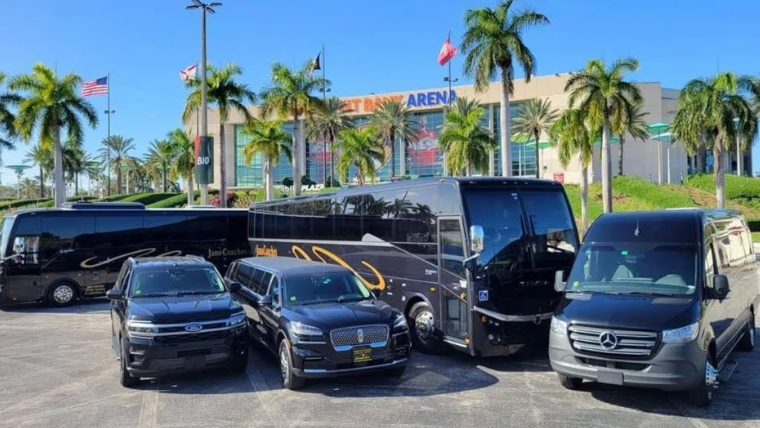
One vehicle (or a small fleet) makes a single run in and a single run out. Everyone leaves together, everyone comes back together. This is the right model when the party has a defined start and end time, the group is predictable, and you want the simplest possible logistics. A charter bus fits larger parties; a Sprinter van covers mid-size groups up to about 14 passengers per vehicle. The tradeoff is flexibility — if someone wants to leave early or stay late, they’re on their own for the ride.
4. Hybrid: Shuttle Loop Plus Late-Night Safe-Ride-Home Service
A shuttle loop runs during the arrival window to handle the rush, then chauffeured sedans and SUVs take over for the staggered late-night departures as the party winds down between 10:30 PM and 1:00 AM. This is the operational model that handles both the attendee-experience and the safe-ride-home objectives cleanly for a mid-size or large corporate holiday party. It’s more complex to coordinate than the other three, which is why it tends to be the model operators like Larry’s build custom for established corporate accounts.
Request a Holiday Party Transportation Quote
The best dates in December book early — mid-November is usually the latest window for prime weekend slots. If your party is on the calendar, now is the time to lock in transportation that fits your headcount, your venue, and the way you want the night to feel.
Vehicle Selection by Party Size
Once you’ve picked the operational model, the next decision is vehicle class and count. The thresholds below are starting points — your venue, your departure pattern, and whether you want capacity for growth all matter — but they’re a useful reference for benchmarking what a vendor should be proposing.
Small Party (10–25 Attendees)
Executive sedans and SUVs for a point-to-point model, or one Sprinter van (seating up to 14) for a single-run shuttle. Industry pricing typically runs $400–$900 per vehicle for a four-to-six-hour window, depending on class and chauffeur-wait time. For executive-heavy or C-suite dinners, this is often the right fit — see our vehicle choice guide for how to pick between a sedan, SUV, and Sprinter.
Mid-Size Party (25–75 Attendees)
Two or three Sprinter vans, a mini-shuttle bus, or a two-vehicle shuttle loop. Industry pricing typically runs $800–$2,500 for the operation, depending on vehicle count and the hours of coverage. This is the headcount band where the operational model (loop vs. single-run) starts to matter most — a shuttle loop handles the staggered departures that point-to-point and single-run can’t.
Large Party (75–200 Attendees)
A full-size motor coach (seating 50–56) or a coordinated fleet of Sprinters running a shuttle loop. Industry pricing generally falls in the $2,000–$5,500 range for the operation, depending on vehicle mix and coverage hours. This is also the band where the hybrid model — loop for arrival, chauffeured safe-ride-home for departures — starts to earn its keep.
Enterprise Party (200+ Attendees)
A multi-vehicle shuttle operation — usually two or more motor coaches plus a fleet of Sprinters for the hybrid safe-ride-home layer — with a dedicated staging coordinator on-site. Industry pricing varies widely from $5,500 upward depending on fleet mix, coverage hours, and whether a second staging location is involved. For parties this size, the vendor you pick needs documented experience running coordinated multi-vehicle operations — not every operator does.
Common Planning Pitfalls to Avoid
Most holiday party transportation problems trace back to a small number of recurring planning mistakes. Here are the six that create the most expensive outcomes:
1. Booking Vehicles Too Small for the Actual Headcount
Vendor quotes are often based on the “comfortable seated capacity,” not the “legal seated capacity.” A 56-passenger coach with coats, bags, and holiday outfits is realistically a 48–50 person vehicle. Over-book your vehicle count by about 10 percent to leave margin for last-minute RSVPs and the capacity reality check.
2. Ignoring Staggered Departure Patterns
Not everyone leaves at the stated end time. Expect roughly a third of attendees to leave within 30 minutes of dinner wrapping, a third to leave mid-evening, and a third to stay until the venue closes. A single-run model forces everyone onto one departure clock. Plan the model around the real departure pattern, not the printed end time.
3. Skipping the Safe-Ride-Home Program
The biggest preventable liability exposure for a hosted-alcohol corporate event. Even a modest ride-home program — subsidized rideshare, chauffeured service for anyone who wants it, or a shuttle loop that runs until the venue closes — materially reduces risk and signals employee care. Confirm the specifics with your company counsel; don’t skip it on cost grounds.
4. Confirming Venue Loading-Zone Logistics Too Late
Not every venue has a loading zone that fits a 40-foot motor coach, and not every venue allows late-night staging in the main drive. Confirm with the venue’s event coordinator at least four weeks out whether your vendor’s largest vehicle can access the drop-off and whether staging can hold during the party. This also applies to event transportation for non-party corporate events.
5. Defaulting to Rideshare for a Formal Corporate Event
Uber and Lyft can work for individual commuting but create problems at scale for a formal event: surge pricing on a Saturday night in December, no accountability if a driver cancels at pickup, no coordinated staging at the venue, and nobody for the company to call when the ride-home logistics go wrong. For a company event with any ride-home expectation, this is a vendor relationship, not an app transaction.
6. Not Verifying the Vendor’s Commercial Livery Insurance
Florida requires for-hire passenger vehicle operators to carry commercial livery insurance at coverage levels that materially exceed a personal auto policy. Before you book, ask the vendor for a certificate of insurance and verify the coverage levels. Many smaller operators and most peer-to-peer rideshares don’t carry commercial livery coverage at the levels a corporate event vendor should. Our corporate account setup guide covers the full vendor-vetting checklist.
Frequently Asked Questions About Corporate Holiday Party Transportation
Here are answers to common questions planners ask about corporate holiday party transportation in South Florida:
How far in advance should I book transportation for a corporate holiday party?
Book transportation for a corporate holiday party four to eight weeks in advance for most providers, and six to eight weeks ahead for the preferred operators that get booked first in December. Mid-November is typically the latest reasonable window for prime weekend dates in December. Deposits are usually 25–50 percent of the quoted total and lock the vehicles on your date.
What's the best way to handle employee rides home after a corporate holiday party where alcohol is served?
The most common approach is a planned transportation program — either a shuttle loop that runs until the venue closes, chauffeured safe-ride-home service, or subsidized rideshare — paired with a clear communication to attendees that rides are available. This reduces the host-liability exposure that comes with serving alcohol and signals employee care. Confirm the specifics with your company counsel, since host-liability rules vary by circumstance.
How much does corporate holiday party transportation cost in South Florida?
Industry pricing in South Florida generally runs $400–$900 for a single executive sedan or SUV, $800–$2,500 for a mid-size shuttle operation (25–75 attendees), and $2,000–$5,500 for a larger party (75–200 attendees) with a motor coach or coordinated shuttle fleet. Enterprise parties over 200 attendees start around $5,500 and scale from there. The main cost drivers are vehicle class, hours of coverage, pickup-point count, and late-night surcharge windows.
What vehicle should I book for a 50-person company holiday party?
For a 50-person holiday party, the two most common options are a mini-shuttle bus for a single-run model or two Sprinter vans running a shuttle loop. If you expect departures to spread across a two-to-three hour late-night window, the shuttle loop is usually the better fit. If everyone will leave together at a defined end time, the mini-shuttle is simpler and often less expensive.
Can one transportation vendor handle both shuttle service to the venue and safe-ride-home service after the party?
Yes — this is the hybrid operational model, and it’s a standard offering for corporate transportation vendors with a mixed fleet. The vendor runs a shuttle loop or group transport during the arrival window, then switches to chauffeured sedans and SUVs for the staggered late-night departures. Working with one vendor keeps the chauffeur radio coordination simple and avoids the cost of two separate vendor contracts.
Planning a Corporate Holiday Party in South Florida?
Larry’s Private Car & Limousine has provided corporate holiday party transportation across Broward, Miami-Dade, and Palm Beach counties for more than 30 years — shuttle loops, chauffeured safe-ride-home programs, Sprinters and motor coaches for larger parties. We’ll help you build the right program for your headcount, venue, and timing, with the chauffeur standards and commercial livery insurance a corporate event needs.